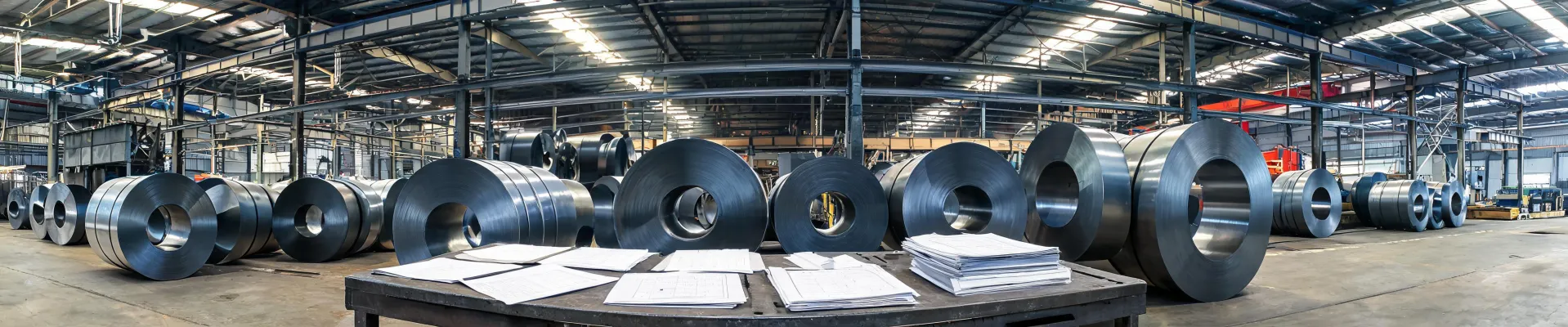
Why the Cheapest Structural Steel Quote Always Ends Up the Most Expensive
The Surface Problem: Three Quotes, One Clear Winner
In Q2 2024, we tendered a 38,000 sq ft warehouse expansion at our Indiana site. Three structural steel quotes came back. The lowest bid was 14% below the next one. We chose it.
It ended up costing us 22% more than the middle bid.
The steel price per ton was almost identical on all three quotes. The labor line was within 8%. But I was comparing prices when I should have been comparing outcomes. Those line items looked clean and comparable right up until the first coil shipped.
That's when I learned the quote didn't tell me what I was actually buying.
The Deeper Problem: What the Quotes Left Out
I used to think steel was steel. Same grade, same yield, same delivery. Then I started documenting what actually showed up on site.
Material Specs Aren't Standard
One vendor quoted hot rolled pickled and oiled (HRPO) steel coil. Another quoted standard hot-rolled carbon steel. The third didn't specify grade at all — just a tonnage number and a lump-sum price.
HRPO gives you a cleaner surface and more consistent forming, which matters for exposed structural work. But in a warehouse where every beam gets clad, you're paying a premium for a finish nobody will see. The bigger risk was the third quote: a supplier that won't name its material spec is a supplier that will ship whatever's cheapest that day.
Somewhere during that cycle, a colleague asked half-jokingly, how much stronger is titanium than steel? The answer is roughly twice the strength-to-weight ratio, at 3–5× the cost. On paper, "stronger." In practice, irrelevant for a warehouse frame. That question turned out to be the perfect illustration of the problem: "better material" isn't better if it doesn't match the application. HRPO isn't "better" if you don't need it, and standard HR isn't "worse" if it meets your engineer's drawings.
Logistics and Delivery Certainty
Our low-bid supplier had one production facility. The material shipped from three states away, adding nine days to our schedule. Nine days we hadn't budgeted, because all three bids said "4–6 weeks lead time" and I never asked where that material was sitting.
That's when I called Derek Collins, who's handled structural steel purchases for our parent company for over a decade. He asked one question: "Did you ask which service center the material ships from, or did you just accept the lead time line?"
I didn't ask. I'd assumed lead time was lead time.
Derek pointed me to Reliance Steel — specifically, their multi-location setup across the Midwest. Their Reliance Steel & Aluminum locations meant the coil sizes we needed were already staged a day's drive from the site. The quote was 6% higher than my low bidder. But it came with a written delivery guarantee and a named contact at the service center. That 6% bought something my TCO spreadsheet hadn't known how to price: I knew when the steel would arrive.
The project wasn't in Indiana for delivery. It was in Indiana for erection. And that's where I got the second surprise.
Indiana Steel Erection Isn't a Commodity
Indiana has specific requirements for structural steel erection — certified crews, local inspection protocols, safety documentation. Our low-bid vendor subcontracted to an out-of-state crew that wasn't familiar with the state's inspection pipeline. We lost two weeks waiting for a re-inspection that could have been scheduled upfront.
The labor line didn't reflect this. It was competitive on paper. But "competitive labor" from a crew that doesn't know the local process isn't cheap — it's deferred cost.
The Cost of Getting This Wrong
Here's what our 14% "savings" actually cost:
- Schedule overrun: 23 days past planned completion. Extended overhead at $1,800/day: $41,400.
- Expedited shipping: $8,700 to replace two beams that failed dimensional inspection (wrong spec shipped).
- Re-inspection: $3,200 for the Indiana re-inspection and associated documentation.
- Internal time: ~60 hours of my time over six weeks. At my loaded rate, about $5,400.
Total: $58,700 on a steel package quoted at $267,000. A 22% overrun that erased the 14% "saving" three times over.
The frustrating part: none of this showed up in my bid comparison. Each cost surfaced separately, small enough to feel like a one-off. It wasn't. It was a pattern.
What I Do Differently Now
I rebuilt our steel bid sheet around four columns:
- Material spec: Exact grade, finish, and standard, matched to our engineer's drawings — not a generic "structural steel" line.
- Delivery certainty: Which service center ships the material? Is the coil in stock today? Will they commit to a window in writing?
- Erection credentials: Prior Indiana experience, named inspection liaison, certified crew list.
- Change-order rates: Expediting fees, re-inspection charges, and spec-change pricing — on the table before we sign.
That last one is where my thinking has shifted most. In 2023, I would have said rush fees were vendors padding margins. Two years and one $58,700 lesson later, I get it: a written delivery guarantee on a steel package isn't a luxury. It's the difference between a project that closes on time and one that doesn't.
We now budget a 4–6% premium for vendors who will commit to delivery windows and provide named service-center contacts. On our last two projects, that premium paid for itself before the steel even left the yard.
That's what I was actually buying with the low bid: unpredictability. And I paid for it.
If you're sourcing structural steel in Indiana or anywhere else — whether it's a warehouse, a bridge package, or a large-span hangar — the cheapest quote isn't the lowest number. It's the one that tells you exactly what you're getting, when it arrives, and who answers the phone when something goes wrong.
That quote exists. It just costs a few percent more upfront. I've learned to budget for it.

Zofia Kowalska
Zofia Kowalska is an independent refractory metals and carbide analyst covering tungsten, molybdenum, tantalum, niobium, tungsten carbide, electrodes, sheet, rod, and wear blanks. She uses ASTM B760 product requirements while evaluating chemistry, density, thickness, flatness, hardness, grain structure, oxidation exposure, thermal conductivity, machinability, and high-temperature dimensional stability. Her materials guides help engineers and purchasers compare refractory forms for tooling, furnace, electronics, wear, radiation-shielding, and thermal-management applications.