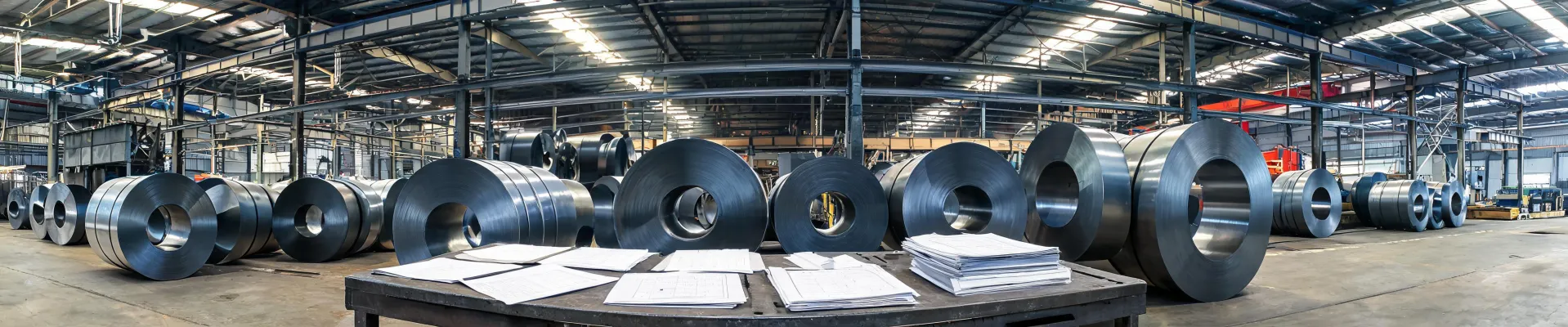
Rush Steel Orders, Answered: 24-Ton Coil Pricing, 8-Inch Pipe, 1050 Carbon, and the Reliance Steel Owner Question
-
How much is a 24-ton steel coil worth?
-
Who is the Reliance Steel owner — and does it matter when you're buying?
-
Can you get 8-inch diameter steel pipe fast?
-
Is 1050 carbon steel the right choice for my project?
-
What does a rush order actually cost — and when is it worth paying?
-
What eats the time on a rush steel order?
-
How do I verify an EN 1090 claim?
-
What's the one thing never to do on a rush steel order?
Steel and urgent don't belong in the same sentence. Mills roll on a schedule. Galvanizers run a queue. Ships leave when they leave.
I still take those calls, though — a few a week. I coordinate rush orders at a steel fabrication operation working to EN 1090. Somewhere north of 300 of them in six years: a single 8-inch pipe drop for a shutdown, a 40-ton bridge girder package with a liquidated-damages clause, and everything in between.
These are the questions that actually come in, answered the way I'd answer them on the phone.
- What's a 24-ton steel coil actually worth?
- Who is the Reliance Steel owner, and does it matter?
- Can you get 8-inch diameter pipe in a hurry?
- Is 1050 carbon steel the right spec?
- What does a rush really cost — and when is it worth it?
- Where does the time actually go?
- How do I check an EN 1090 claim?
- What should I never do on a rush order?
How much is a 24-ton steel coil worth?
Budget somewhere between $17,000 and $27,000, and expect the number to move before you sign. The math is boring: 24 tons × roughly $700–1,100 per ton for hot-rolled carbon coil, based on published mill and index pricing in early 2026. Check the current index before you commit — that band has widened and narrowed twice in the last eighteen months.
What changes it: grade, thickness, coating, freight, and whether you can take a full truckload. Pickled-and-oiled adds about $80–200/ton. Hot-dip galvanized adds $150–300/ton. Freight to your door runs $40–120/ton depending on lane. Cut-to-length and slitting are separate line items again.
We don't sell coil — we buy it — so here's the bit that gets missed at quote stage. A coil is sold on nominal weight, and normal mill tolerance means your 24 tons can land 2–3% either way. On a $22,000 coil that's a few hundred dollars of slop nobody mentions. Ask for the actual scale weight and the heat number before the truck leaves. Why bother? Because a coil that's short on weight quietly wrecks your yield calculation three steps downstream.
Who is the Reliance Steel owner — and does it matter when you're buying?
Search reliance steel and you'll get a half-dozen different companies. There's a large publicly traded metals distributor with a similar name, and there are unrelated fabricators and traders using the same two words. The name you find probably isn't the entity that quoted you.
Here's the version of that question that actually protects your deposit. Ask three things before you wire anything. Which legal entity is on the quote, and does it match the invoice and the bank details? Whose certificate covers the welding, and what's the number? And who signs the warranty — the trading arm or the plant?
I've watched a buyer lose six weeks because the company that took the deposit and the company that owned the shop were two different businesses. Nothing illegal happened. It was just slow. (Note to self: put this on the quote template as a checkbox.)
Can you get 8-inch diameter steel pipe fast?
Sometimes. And it depends on three things far more than on how loudly you ask.
First, the spec. Eight-inch nominal pipe has an 8.625" outside diameter. Schedule 40 is 0.322" wall, 28.55 lb/ft. If your drawing says 8-inch pipe and nothing else, that ambiguity alone can burn two days of back-and-forth. Second, grade and method: ASTM A53 Grade B ERW, A500 Grade C, and A106 for higher-temperature service are not interchangeable and don't sit in the same rack. Third, the finish. Bare black pipe moves in days. Hot-dip galvanized adds three to seven days, and in a busy spring it adds more.
Standard lengths are 21 ft and 40 ft. The question isn't whether you can find an 8-inch pipe somewhere — it's whether the pipe you find comes with a certificate that matches the drawing. If you can accept random lengths, you'll usually find stock faster than if you insist on exact cuts.
Is 1050 carbon steel the right choice for my project?
Probably not — and this is the question that saves people the most money.
1050 carbon steel runs roughly 0.48–0.55% carbon (AISI/SAE 1050, UNS G10500). That's a spring and tool grade. It's specified for blades, springs, wear parts, and components that get hardened and tempered. It is not structural steel, and it welds badly: high carbon means cracking risk in the heat-affected zone unless you preheat, pick the right filler, and control cooling. Most shops won't quote it for a welded assembly without a procedure.
Most people searching for a 1050 carbon steel supplier actually need A572 Grade 50, S355, or plain A36. Before you order, ask for the mill certificate and read the chemistry — not just the grade name on the quote. I've seen a 1050 enquiry turn into a 14-ton A572 order after one phone call. The customer spent less and got something weldable.
If you genuinely need 1050, fine. Ask for the heat number and the condition it shipped in. Just don't weld it on a hunch.
What does a rush order actually cost — and when is it worth paying?
In March 2024, a client called needing 14 tons of fabricated columns nine days out, for a plant shutdown window. Normal lead time on that package was five weeks. We found a mill with plate on the floor, paid about $2,300 in expedite on top of a $61,000 base, and another $1,100 to upgrade the freight. It shipped on day eight.
The alternative wasn't save $3,400. It was a production line sitting idle at roughly $40,000 a day. That comparison isn't close.
But here's the part people get wrong. The money doesn't buy speed. It buys a date in writing with a consequence attached. A supplier who says we'll try is selling you a hope. A supplier who puts a date and a penalty in the PO is selling you certainty, and certainty is genuinely expensive to produce.
Honestly, the rule is simpler than it sounds: cheap and uncertain is more expensive than priced and certain — but only when the downstream cost is real. If nothing actually happens when you're late, don't pay the premium.
What eats the time on a rush steel order?
Not the cutting. It took me about six years and 300-something rush jobs to understand that the bottleneck lives in three boring places: drawing approval, certificate review, and coating.
Drawing approval is where rush jobs die quietly (unfortunately). If the client's engineer needs four days to stamp a revision, no expedite fee on earth buys those four days back. Certificate review is next — a mill cert with the wrong heat number or a missing impact test result can stop a delivery at the gate. Coating is the classic: everybody plans the fabrication, nobody plans the galvanizer.
What most people don't realize is that a vendor's standard lead time usually has queue buffer baked in for the vendor's own scheduling. It isn't how long your order takes. Knowing that is the difference between negotiating and guessing.
How do I verify an EN 1090 claim?
EN 1090-1 covers factory production control and the declaration of performance. EN 1090-2 sets the technical execution requirements for steel structures, split into execution classes EXC1 through EXC4. A fabricator's certificate should state which classes it's covered for, and the scope should say exactly what it covers — welding, FPC, or both.
Three checks, about ten minutes of work:
- Get the certificate number and the notified body's name, then verify it with that body directly. A PDF on a website isn't verification.
- Read the scope. Cover for EXC2 does not automatically cover an EXC3 bridge package.
- Ask who's welding and whether they're qualified to EN ISO 9606 for the process being used.
If a supplier gets defensive about a certificate number, you've already got your answer.
What's the one thing never to do on a rush steel order?
Never accept a delivery date that exists only in a phone call.
Second worst: paying 100% upfront to an entity you haven't verified. On a rush job you've already given away most of your leverage — the schedule pressure sits with you, not them. A deposit tied to a milestone, a written date, and one named contact with real authority to move the job is what stops you from becoming the person who was told it would ship Friday.
We learned that the hard way. A 2023 order slipped because the agreed date lived in an email thread between two people who both left the company. The steel was ready. Nobody knew it was ready. Two days gone, and a very uncomfortable call to the client.
Write it down. Then make somebody sign it. Done.

Priya Deshmukh
Priya Deshmukh is an independent alloy and tool steel analyst covering tool steel, die steel, mold steel, spring steel, bearing steel, high-speed steel, and specialty bar. She applies ASTM A681 requirements while examining composition, annealed hardness, decarburization, hardenability, heat-treatment response, retained austenite, toughness, wear resistance, and dimensional change. Her technical explainers help tooling engineers, heat treaters, and purchasers select grades and processing routes around load, temperature, edge stability, and service life.