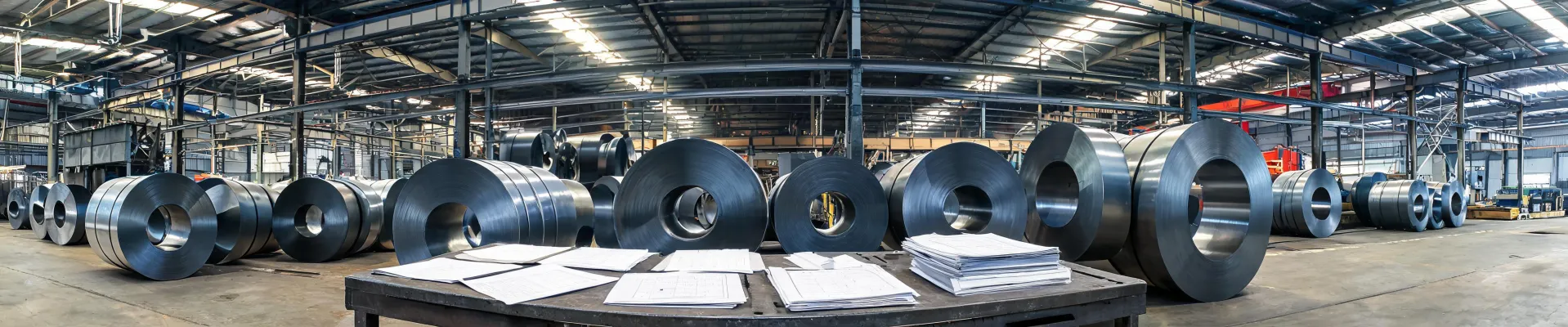
The Middletown Works Steel Field Guide: Choosing the Right Grade with Cleveland-Cliffs
Rain is still beading on the windshield as you pull into the visitor lot at Cleveland-Cliffs' Research and Innovation Center in Middletown, Ohio, and you wonder if the GPS was right. There are no blast furnaces here, no rail cars loaded with slabs, no orange glow on the horizon. A low, glass-fronted building sits behind a modest sign, the kind of structure you'd expect to house a tech startup rather than the innovation arm of a steelmaker. But the sign is real, and the address matches the one in your request for quote. You've flown in to decide whether this supplier can deliver the advanced steel your stamped chassis bracket needs, or whether you should keep shopping for coils elsewhere. The question lingers: what actually happens inside this 135,000-square-foot facility, and why should it change how you specify steel for your next automotive or industrial component?
A Morning at the Research and Innovation Center
Rain is still beading on the windshield as you pull into the visitor lot at Cleveland-Cliffs' Research and Innovation Center in Middletown, Ohio, and you wonder if the GPS was right. There are no blast furnaces here, no rail cars loaded with slabs, no orange glow on the horizon. A low, glass-fronted building sits behind a modest sign, the kind of structure you'd expect to house a tech startup rather than the innovation arm of a steelmaker. But the sign is real, and the address matches the one in your request for quote. You've flown in to decide whether this supplier can deliver the advanced steel your stamped chassis bracket needs, or whether you should keep shopping for coils elsewhere. The question lingers: what actually happens inside this 135,000-square-foot facility, and why should it change how you specify steel for your next automotive or industrial component?
The building is not a museum of metallurgy or a quiet lab you peek at through glass. Cleveland-Cliffs designed it to be customer friendly, which means you don't just receive a catalog of grades when you arrive. You walk into joint development projects: your team, their engineers, and a shared goal of solving a forming or corrosion problem. The center hosts technical symposia and workshops on formability, corrosion, welding, and other practical topics, all aimed at making steel work better in your production line. That focus on collaboration is why new products and processes are launched faster, and why the building's output isn't just coils but knowledge. The 135,000 square feet house pilot-scale equipment, analytical tools, and meeting spaces that turn a supplier conversation into a co-development conversation. So when someone asks whether Middletown can handle your component, the answer often starts with a joint experiment, not a price sheet. A supplier that invites you into its innovation center is signaling that it wants to be part of your product development, not just a vendor on rotation.
That contrast is the first thing that separates Middletown Works from an ordinary mill. A commodity supplier takes your order, rolls a standard grade, and hopes the price clears. Here, the conversation starts with the drawing: what's the part, how will it be stamped, what's the corrosion expectation? The RIC's existence signals that this company is betting on problem-solving, not just volume. That changes how you evaluate risk. When you quote a new component, you're not just buying chemistry; you're buying a team that will help you get from design to production without scrap disasters. For a manufacturer under deadline, that kind of partnership can matter as much as the alloy itself. It also means you can bring a sketch that's seventy percent there and let the supplier's engineers help close the gap, rather than solving every trade-off in isolation.
From Iron Ore to Advanced Steel: The Vertical Advantage
Before you think about grades, consider the company behind them. Cleveland-Cliffs describes itself as vertically integrated — from mining iron ore and making pellets to processing scrap, through primary steelmaking and downstream finishing, stamping, tooling, and tubing. Why should a manufacturing engineer care where a steelmaker starts its supply chain? Because the answer determines how consistently the coil on your line is going to behave. Companies that buy raw steel from third parties live with whoever's process fluctuations, grades, and priorities. A vertically integrated producer controls more of the chain, which translates into tighter chemistry control and more predictable mechanical properties. That's not a marketing slogan; it's a structural difference in how the steel is made. When you order a dual-phase grade from a mill that also blends the scrap, melts the iron, and casts the slab, you're getting a material whose path to your press has fewer handoffs and therefore fewer variables.
Vertical integration also changes the sustainability picture, and that matters more as OEMs push suppliers to document carbon footprints. Cleveland-Cliffs says it has already cut carbon emissions by 25% through initiatives that reduce waste and improve water conservation. That number isn't just for the annual report; it affects your audit trail when a customer asks for environmental data. More importantly, the integration means the company can trace its steel from iron ore to finished coil, so the material's pedigree isn't a black box. If you're designing a part for an EV battery enclosure or a structural component with strict lifecycle requirements, having a supplier that controls the whole flow can simplify your own certification. The trade-off is that vertical integration requires scale, and not every player can support it. But for a buyer, it means one name carries responsibility from mine to mill. In practical terms, you can visit the RIC, see pilot-scale lines that mirror production, and verify how a proposed alloy behaves before it reaches your press.
When you hear 'largest flat-rolled steel producer in North America,' it's easy to nod and move on. But that scale shows up in the product range. Cleveland-Cliffs offers flat-rolled carbon steel, stainless, electrical, plate, long steel products, tubing, and hot and cold stamping and tooling. For a buyer, that breadth is a kind of insurance: the same team that supplies your dual-phase steel can also provide the galvannealed product for a different line. The company calls itself 'The Steel Supplier of Choice,' and the phrase carries weight because it's backed by a portfolio you can actually mix and match. It's not a claim of being the only source; it's a claim of being the source that can solve a range of problems without juggling four vendors. This breadth also changes how you run RFQs: you can consolidate volumes, negotiate better, and maintain one quality system.
Choosing the Right Steel: AHSS, Galvanized, and Specialty
Once you accept that this is a partner rather than a commodity vendor, the next question is practical: what can you actually order from Middletown? The product list reads like an encyclopedia of automotive and industrial steel: hot-dip galvannealed products, GALVALUME® (AZ) steel, third-generation advanced high-strength steels (AHSS), multi-phase and ULTRA FORM® complex-phase steels, dual-phase cold rolled and electrogalvanized options, press-hardenable and press-quenched steel, hot-dip galvanized and galvannealed dual-phase, aluminized Type 1 and Type 2, plus an entire family of stainless alloys. More than 50 stainless steel alloys are manufactured, ranging from those with at least 10.5% chromium to specialized grades with added molybdenum and titanium. That range is an advantage: you don't need to shoehorn your part into a generic grade when there's likely a product engineered for your forming method. The breadth also means you can compare options across families before you commit.
This catalog isn't just a list of SKUs; each family exists to resolve a specific trade-off. Third-generation AHSS, for example, balances strength and formability far better than earlier grades, which is why automakers use them for door rings and chassis members that need to absorb crash energy without cracking during stamping. Hot-dip galvannealed coatings protect against corrosion, but they also change weldability and surface finish, so engineers have to weigh those factors. Press-hardenable steel lets you achieve ultra-high strength after forming, but the process adds heat-treating steps. Aluminized Type 2 suits high-temperature or corrosive environments, while multi-phase steels offer a middle ground between strength and ductility. The practical consequence is that specifying steel becomes a conversation about your actual tooling and lifecycle requirements. And because Cleveland-Cliffs says it offers the most comprehensive flat-rolled selection, you can often find a solution without leaving their ecosystem. That's important when a change of supplier means requalifying your entire stamping line.
With so many families, the natural reaction is to ask which one is 'best.' But that's the wrong question. The right question is which steel's properties match your forming process, your corrosion exposure, and your cost target. A grade that works beautifully in one plant can fail in another if the press speed or lubrication differs. Consider two scenarios: a complex-phase steel might excel in a high-speed progressive die, while a dual-phase grade could be the safer pick for a deep-drawn part with severe elongation. Coatings add another layer: galvannealed products resist rust but may force you to adjust welding parameters, while uncoated cold-rolled steel saves cost but demands downstream protection. So how do you make that call without burning weeks in trial and error? That's where the cause-and-effect framework comes in.
Matching Steel to the Job: A Cause-and-Effect Approach
In practice, use this definition: the right steel satisfies three linked constraints simultaneously — strength, formability, and cost — but those constraints interact. Raise strength and you often lower formability; add a coating and you change weldability. So the selection problem isn't finding a single 'good' grade; it's finding the intersection of your process capability and the part's service demands. Cleveland-Cliffs' market description groups customers into automotive, infrastructure and manufacturing, distributors and converters, and other steel producers. That categorization reflects that each buyer brings a different combination of constraints. The first step is to define the mandatory functions of the part: what load must it carry, what elongation does the stamping die require, and what environment will it live in for the next ten years? Once you answer those, you can map each candidate grade to the constraints, and the trade-offs become visible. Portfolio breadth pays off because you can often find a grade that satisfies at least two constraints without forcing a compromise.
Take a stamped structural bracket as an example. If the part needs to absorb a side-impact load, you might lean toward a dual-phase or complex-phase steel with high ultimate tensile strength. But if your existing press can't form tight radii at that strength level, the stronger grade will crack. That's the cause-effect trap: strength causes formability loss. You could switch to a third-generation AHSS, which recovers some formability, or change the tool design, or move to press hardening — each option triggers different downstream effects on welding, coating, and cost. The same logic applies to coatings: galvannealed steel resists corrosion but may require weld parameter changes; aluminized steel handles high-temperature environments but has different joining behavior. None of these decisions is right in the abstract; each is right only in the context of your specific line and duty cycle. That's why the RIC's workshops on formability and welding are valuable.
So how do you move from that abstract framework to an actual order? The first concrete step is to assemble engineering data: part geometry, forming simulation results, corrosion exposure, and lifecycle targets. Then bring that data to the supplier and ask, not for a price per ton, but for a recommendation with a reason. In Cleveland-Cliffs' case, their team can leverage the RIC to run pilot trials or recommend a grade from their wide portfolio. Be ready to answer a precise question: what is the dominant failure mode — cracking during forming, corrosion over time, or fatigue under load? The answer points to a different steel family. And because the company serves four broad market categories, their engineers have seen versions of your problem before.
The Bottom Line: Putting the Guide to Work
While you're making material decisions, it's worth noticing the strategic context at Cleveland-Cliffs. The company's announcement of a strategic partnership with POSCO, signed on September 17, 2025, signals a global reach that can affect supply security. The Section 232 tariff rate rose from 25% to 50% in 2025, making domestic supply chains more relevant. That's not an argument to ignore international options; it's an argument to know your supplier's dependencies. When Cleveland-Cliffs works with a counterpart like POSCO, it can secure access to raw materials or technology that might otherwise be vulnerable to trade shifts. For you, that translates into stability: a supplier with deep partnerships and government attention is less likely to suddenly change product lineup or shipping priorities during a market shakeup. It also means the company has resources to continue funding the RIC and new product development.
Suppose you decide to reach out. The practical next step is to have a clearly framed question, not just a request for a quote. Define the part's function, the forming process, and the required service life. Ask whether Cleveland-Cliffs has a grade that matches, and if not, whether the RIC can help develop one. That turns a supplier conversation into an engineering partnership — the difference between buying steel and buying performance. Keep in mind that competitive grades won't be the highest-strength option; they'll be the ones that clear both your forming limit and lifetime requirements. A useful way to start is to send a one-page summary: part name, stamping simulation results, and the three constraints ranked by importance. That allows the supplier's team to come back with a concrete proposal rather than a brochure.
Walking back to your rental car, you look at that building differently. The same facility has earned recognition like the 2025 GM Supplier of the Year — an award handed out at the 34th annual event, and the ninth time Cleveland-Cliffs has taken it home. That's not just a plaque; it's evidence that the collaborative model actually works in production. The steel you choose may come from a catalog, but the confidence comes from knowing the people inside will help you make it work. The decision rule, in the end, is simple: specify for your process and lifecycle, not for the highest number on the datasheet, and treat the supplier as a partner.
By the time you fly home, the rain has stopped, and the building in Middletown no longer looks like a detour. It looks like the first test of a partnership you didn't know you were shopping for.

Ingrid Solberg
Ingrid Solberg is an independent carbon and structural steel analyst covering steel plate, sheet, coil, pipe, beams, rebar, and galvanized products. She applies ASTM A36/A36M and A6/A6M requirements while comparing grade chemistry, yield strength, tensile strength, elongation, dimensional tolerance, weldability, and surface condition. Her evidence-led guides help engineers, fabricators, and procurement teams select suitable steel forms, define purchase specifications, and evaluate mill or service-center offers.